
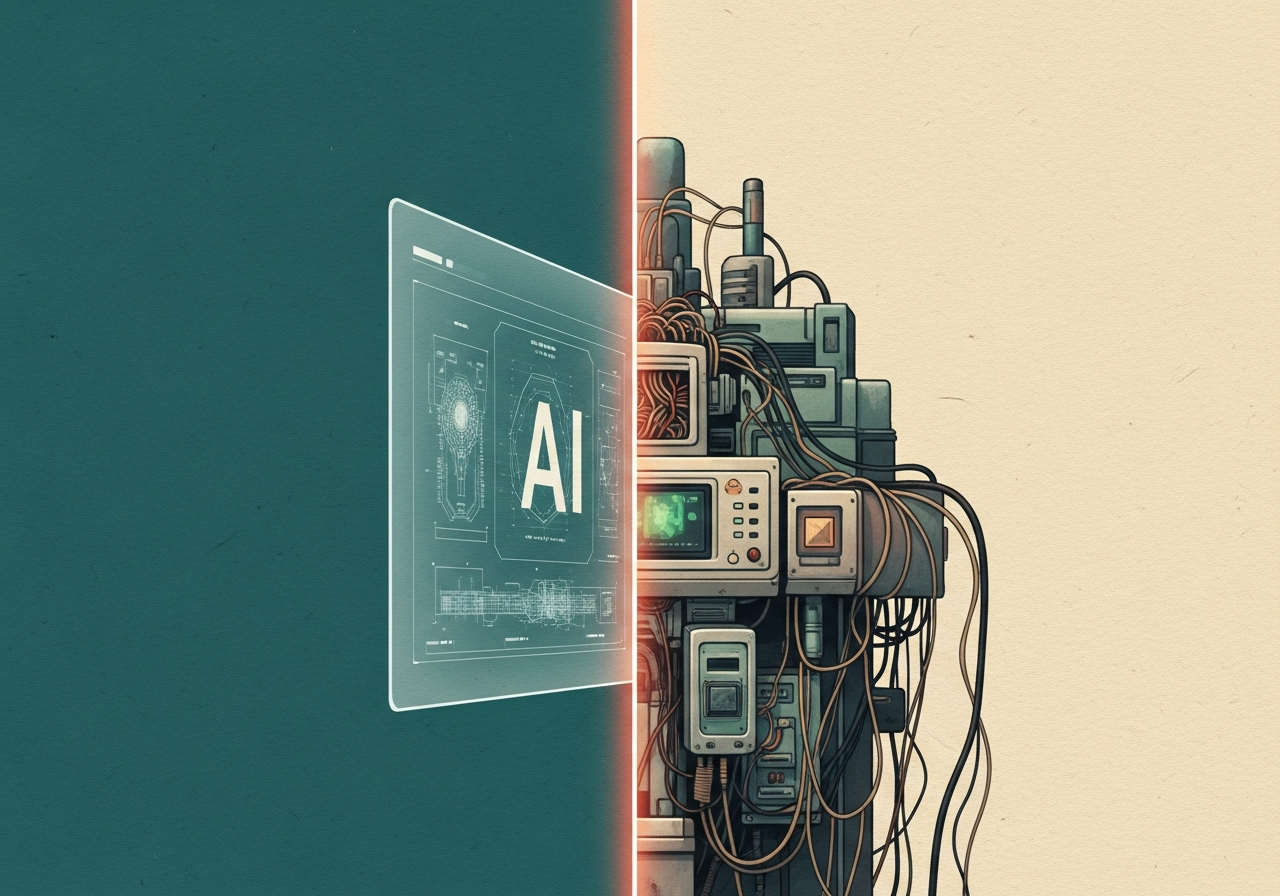
The most dangerous part of healthcare AI is often not the model.
It is the seam underneath it.
The point where a modern AI product plugs into a practice management system built for a different era. The point where a clean interface depends on a messy database. The point where a chatbot, scribe or agent inherits the weakness of the infrastructure it sits on top of.
That seam is where risk accumulates.
Healthcare has a habit of talking about AI as if the model is the whole story. Is it accurate? Is it empathetic? Does it hallucinate? Can it reason? Can it summarise? Can it triage?
Those questions matter. But they are incomplete.
An AI system does not operate in a vacuum. It operates inside a clinic, a hospital, a fragmented data environment, a compliance regime, a set of human workflows, and a history of systems that were never designed to work together.
If that foundation is brittle, AI does not remove the brittleness.
It can amplify it.
Healthcare Looks Modern From the Front
Most patients see healthcare through the front end.
The booking link. The online form. The reminder text. The portal. Increasingly, the AI assistant.
Those interfaces can look modern. Sometimes they are modern. But behind them sits a stack that is usually more complicated than the patient, and sometimes the clinic, realises.
There is the practice management system. The electronic record. The payment provider. The marketing tool. The inbox. The call system. The WhatsApp workaround. The spreadsheet that someone created three years ago and everyone still trusts. The free-text note that contains the context nobody structured. The second record for the same patient because they used a different phone number.
This is not unusual. It is the normal operating environment.
Healthcare data is fragmented because healthcare work is fragmented. A patient's relationship with a clinic does not happen in one channel. It happens across calls, appointments, forms, emails, messages, invoices, notes and informal memory.
That fragmentation is manageable when humans are the only actors. Not ideal, but manageable. A receptionist remembers the patient. A clinician knows the background. Someone checks the spreadsheet. Someone asks the person who was there last week.
AI changes the risk profile because AI can act at speed and at scale.
If it sees the wrong record, it can act on the wrong patient. If it sees incomplete context, it can produce a confident but unsafe answer. If the access model is too broad, it can expose more data than the task requires. If audit is weak, the clinic may not be able to reconstruct what happened.
The same fragmentation that was previously inconvenient becomes a safety and security issue.
Banking and Healthcare Rhyme
Before building healthcare software, I spent time in environments where modern systems had to sit directly on top of old infrastructure. Banking is a good example. You can build a beautiful new product, but somewhere underneath it may be a system that nobody can simply switch off.
Healthcare is similar, and often more emotionally charged.
You cannot rip out every legacy system and start again. Clinics cannot pause care while the stack is rebuilt. Hospitals cannot wait for the perfect architecture. The work has to continue.
So the real engineering job is not pretending the old world does not exist.
The job is containment.
Reduce blast radius. Mask data where possible. Gate access. Make the secure path the default. Design auditability into the workflow. Assume that systems will fail, integrations will be partial, and humans will need to understand what happened afterwards.
That is less exciting than a product demo.
It is also the work that makes the demo safe.
AI in healthcare needs this discipline more than almost any other software category because the consequences are layered. A failure is not just a bad user experience. It can be a privacy incident, a clinical escalation miss, a regulatory problem, a trust failure and an operational mess at the same time.
The AI Agent Inherits the System
There is a common assumption in AI procurement: the AI product arrives as a layer of intelligence on top of existing systems.
That can be true.
But it also arrives as a layer of dependency.
If the source data is wrong, the AI has to deal with wrong data. If identity resolution is weak, the AI has to deal with duplicate or mismatched patients. If the workflow is undefined, the AI has to infer intent from noise. If permissions are too broad, the AI may have more access than the task requires. If there is no audit trail, the AI's actions become hard to explain.
This is why "AI readiness" is not just an innovation question. It is an infrastructure question.
The clinics most ready for AI are not necessarily the clinics with the most tools. They are the clinics with the clearest workflows, cleanest data, strongest access controls and best understanding of where human judgement belongs.
A simple system used well is often safer than a sophisticated system used badly.
This matters because many healthcare organisations already use only a fraction of the tools they have. Adding AI to that environment can create a false sense of progress. The interface improves, but the underlying operating model has not changed.
The risk is a clinic that looks more modern while becoming harder to govern.
Security Is Not a Tax
Security is often framed as the thing that slows innovation down.
In healthcare AI, that is the wrong frame.
Security is what earns the right to innovate.
A clinic or health system cannot safely automate patient communication, triage, follow-up or operational decision-making if it cannot answer basic questions about data access, audit, permissioning and failure modes. Those are not compliance extras. They are part of the product.
Done well, security makes a system easier to use, not harder. The secure workflow should be the default workflow. The safest path should be the path with the least friction. Engineers should not have to choose between moving quickly and doing the right thing. The architecture should make the right thing normal.
That is especially important in AI because the system boundary is less obvious than in traditional software. A normal application does what the code says. AI systems can interpret, infer, summarise and generate. That makes strict boundaries more important, not less.
What can the model see?
What is it allowed to do?
What must it never do?
When does it stop?
Who reviews the output?
What is logged?
How quickly can the organisation respond if something goes wrong?
These are security questions. They are also patient-safety questions.
Vulnerable People Change the Standard
The stakes are highest when the people depending on the service are least able to absorb a failure.
That is true in healthcare broadly. It is especially true for vulnerable patients, children, people in crisis, older patients, people managing complex conditions, and people who already struggle to navigate the system.
For those groups, resilience is not an abstract engineering value. It is part of the care.
If an AI-powered system gives an inappropriate answer, loses context, exposes sensitive information or makes it harder for the patient to reach a human, the harm is not evenly distributed. The patient with confidence, time and resources may work around the failure. The vulnerable patient may not.
This is why healthcare AI cannot be designed only for the average user in the average case. The average case is not where the duty of care ends.
Systems should be tested against stress, ambiguity and vulnerability.
What happens when the patient is distressed?
What happens when the patient provides partial information?
What happens when the patient asks a question the model should not answer?
What happens when the source systems disagree?
What happens when the integration is down?
What happens when the wrong person receives the right message?
If those questions sound operational rather than futuristic, that is the point. Healthcare AI will fail in ordinary ways before it fails in science-fiction ways.
The Wrong Lesson From AI Progress
The pace of model improvement can make infrastructure work feel boring.
Every few months, models get better at reasoning, summarising, translating and conversing. It is tempting to assume that the model will soon solve the messy parts too.
It will not solve all of them.
A better model does not automatically create clean patient identity. It does not automatically fix a broken access policy. It does not automatically know which record is the source of truth. It does not automatically understand the local workflow of a clinic it has never seen. It does not automatically produce accountability.
Better models are useful. But they raise the importance of the surrounding system because people will trust them more.
That is the paradox. As AI becomes more capable, the foundation matters more, not less.
If the system is going to act on behalf of a clinic, draft patient messages, prioritise inbound requests, summarise records or recommend next actions, the environment around it has to be designed for that responsibility.
The model is only one component.
The architecture is the safety case.
What Healthcare Leaders Should Ask
Before adopting an AI system, healthcare leaders should ask questions that sound less like AI questions and more like infrastructure questions.
Where does the patient context come from?
How does the system reconcile identity across records and channels?
What data does the model not see?
What permissions does it have by default?
How are outputs reviewed, approved and logged?
What happens when the source system is wrong?
What happens when the AI is uncertain?
Can a human reconstruct the decision afterwards?
How does the system reduce blast radius if something goes wrong?
Who is accountable for changing the workflow when failure patterns appear?
These questions are not designed to block AI. They are designed to make AI useful in the real world.
Because the real world is where healthcare happens.
Not in the demo environment. Not in the slide deck. Not in the clean sample dataset.
In the messy seam between old systems, new tools, human judgement and patient need.
That is where healthcare AI will either earn trust or lose it.
Build on Trust
The future of healthcare will include AI. It should. There is too much administrative work, too much fragmentation and too much operational drag for the status quo to be acceptable.
But the organisations that use AI best will not be the ones that bolt intelligence onto fragile systems and hope for the best.
They will be the ones that treat security, resilience and auditability as the foundation.
Not as a tax.
Not as paperwork.
Not as something to add after the product starts working.
As the thing that lets the product safely work in the first place.
The most dangerous part of healthcare AI is often not the AI.
It is the foundation underneath it.
Build that properly, and AI can help care teams do more of the work only they should do.
Ignore it, and the smartest interface in the world is still sitting on a crack.