Less than 1% of the hours a patient spends under a clinic's care happen in the treatment room, as Coherent's founder and CEO Jared Aron puts it. The rest is enquiries, reminders, questions, cancellations, follow-up and recall. Clinics judge the treatment closely. That other 99% rarely gets judged at all.
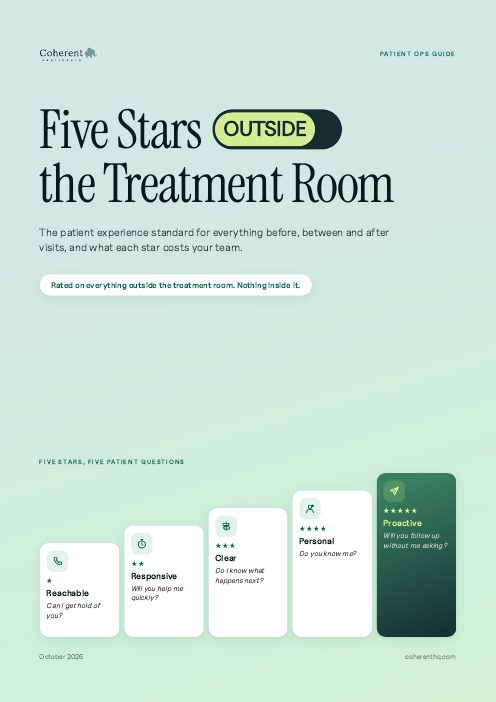
This standard rates exactly that time, with five stars and one patient question per star: Can I get hold of you? Will you help me quickly? Do I know what happens next? Do you know me? Will you follow up without me asking?
A clinic can deliver five-star treatment and a two-star experience around it. This guide shows how to find out which one yours is, and what it would cost your team to move.
01
The other 99%
Most of a patient's time with your clinic happens outside the treatment room.
Rated here
The first enquiry, by phone, form or message. Booking and confirmation. Reminders and questions between visits. Cancellations and missed appointments. Follow-up after treatment, and recall.
Not rated here
Treatment quality and clinical outcomes. The clinician's skill. Premises and equipment. Your clinical standards, your regulator and your outcomes already judge these.
The Michelin rule, reversed
Michelin rates the food on the plate and nothing else. These stars rate everything around the treatment, and nothing in it.
A clinic can deliver five-star treatment and a two-star experience around it.
02
The five stars
Each star answers one question a patient asks outside the treatment room. Earn them in order: a clinic holds a star only when it holds every star below it.
1
Reachable: “Can I get hold of you?”
Passes when a person answers, or calls back the same working day. What it looks like: the call is answered, or returned before close.
2
Responsive: “Will you help me quickly?”
Passes when a useful written reply arrives within one working hour. What it looks like: “Yes, we can see you this week,” 38 minutes after the enquiry.
3
Clear: “Do I know what happens next?”
Passes when every reply gives the price, a way to book and the next step. What it looks like: “An assessment is £65. Book online, or pick a time.”
4
Personal: “Do you know me?”
Passes when every reply uses what the patient has already told you, and nobody asks twice. What it looks like: “Thursday at 6pm, since mornings don’t work for you?”
5
Proactive: “Will you follow up without me asking?”
Passes when patients who go quiet, cancel or miss a visit hear from you first, every time. What it looks like: “Hi Sam, still keen? Two evening slots this week,” sent two days after the enquiry went quiet.
One to four stars: the clinic responds
Reachable, responsive, clear and personal all describe how well a clinic answers once the patient makes contact.
Five stars: the clinic acts first
Proactive is the only star the patient never has to ask for.
Why Proactive is the top star
More staff can make every reply personal. Following up every patient who goes quiet is the hard part: it grows with every patient you see.
Five-star describes a service standard. It is not a review rating or a clinical outcome, and it applies to every patient, from a one-off assessment to a full course of treatment.
03
The five-star map
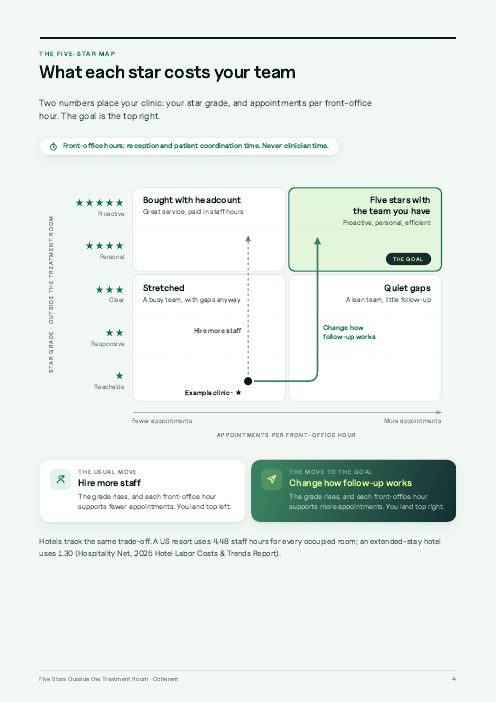
Two numbers place your clinic: your star grade, and appointments per front-office hour. The goal is the top right: five stars with the team you have.
What counts as front-office time
Reception and patient coordination time spent on calls, messages, booking and follow-up. Never clinician time, appointment length or how full the diary is.
The usual move: hire more staff
The grade rises, and each front-office hour supports fewer appointments. You land top left: great service, paid for in staff hours.
The move to the goal: change how follow-up works
The grade rises, and each front-office hour supports more appointments. You land top right.
Hotels track the same trade-off. A US resort uses 4.48 staff hours for every occupied room; an extended-stay hotel uses 1.30 (Hospitality Net, 2025 Hotel Labor Costs & Trends Report). Each extra star costs hours unless the work changes shape.
04
Find your star grade
One genuine enquiry, three working days and five yes-or-no tests: your clinic the way a hotel inspector would see it.
1
Before: choose someone your team will not recognise
A friend or a colleague from another site enquires about price and availability for your most common first appointment. Never book a slot you will not use, or describe symptoms the caller does not have.
2
Day 1: call, then write
Call in opening hours, then send the same question in writing by web form, WhatsApp or email. When the reply comes, answer it once with one detail, such as “weekday mornings don’t work”.
3
Days 2 and 3: go quiet
Leave the enquiry unbooked and watch for a follow-up.
Test
Passes when
★ Reachable: call in opening hours
A person answers, or calls back the same working day
★★ Responsive: send the question in writing
A reply that answers it arrives within 1 working hour
★★★ Clear: read the reply
The price or a price range, a way to book and the next step are all there
★★★★ Personal: reply with one detail
The next reply uses it, and asks nothing already answered
★★★★★ Proactive: leave the enquiry unbooked
A follow-up arrives within 3 working days, unprompted
Counting your grade
Your grade is the number of passes before the first fail. A clinic that replies in ten minutes with prices and times, then never follows up, holds three stars.
In a group, test two sites and take the lower grade.
05
Count appointments per front-office hour
Two numbers from last month. Neither needs new software.
Front-office hours
From the rota: everyone whose job includes patient calls, messages, booking or follow-up, times their hours. Count a full-time role as about 150 hours a month.
Appointments delivered
From your practice management system: attended appointments only. Leave out cancellations and no-shows.
The formula
Appointments per front-office hour = appointments delivered ÷ front-office hours. Higher is better.
Example: a three-site physio group delivered 2,000 appointments with 600 front-office hours. That is 3.3 appointments per front-office hour, at one star.
No public benchmark exists for clinics yet, so judge against yourself: your best site or your best month. Above that, you sit on the right of the map; below it, on the left.
06
Track it every month
One measurement is a snapshot. The trend shows whether your clinic is climbing the map because the work got smarter or because the team got bigger.
Star grade
Re-run the mystery enquiry every month, or at least every quarter, at the same sites.
Appointments per front-office hour
The same two numbers, with the same definitions, every month.
The warning sign
If your grade rises while appointments per front-office hour fall, you are buying stars with headcount.
Questions clinics ask
Does this rate our clinical care?
No. It rates everything outside the treatment room. Your clinical standards, your regulator and your outcomes judge the care itself.
Is this the same as our Google rating?
No. Google stars record how patients felt. These stars check what your clinic does.
Does a better ratio mean fewer staff?
It means each front-office hour supports more appointments. Where that time goes is your decision. The patients who go quiet are the obvious place to spend it.
The bottom line
The treatment room gets judged every day. The other 99% gets judged by patients, quietly, when they decide whether to come back.
Five stars, with the team you have.
Parts 02 to 06Read the rest of the guide.
All six parts, including the mystery-enquiry scorecard, the five-star map and the monthly tracker, ready to use.
No. It rates everything outside the treatment room. Your clinical standards, your regulator and your outcomes judge the care itself.
Is this our Google rating?
No. Google stars record how patients felt. These stars check what your clinic does.
Does a better ratio mean fewer staff?
It means each front-office hour supports more appointments. Where that time goes is your decision.
Part of Coherent
Four modules. One patient journey.
Data finds the gaps, Engage reaches out, Coordinator handles the replies and Payments closes the booking. Start with one, add the rest as your programmes grow.
Coherent brings proactive follow-up and responsive support together, so patients get an answer and take the next step without every conversation becoming another task for your team.